Subscribing to feeds
What if I don't know the feed URL?
Not to worry, we'll autodetect any available feeds from a website URL, and present you with a list you can choose from.
How often will I get updates?
Blogtrottr provides a variety of schedules for you to choose from:
- Real time - every update gets its own email.
- 2/4/6/8/12 hourly or daily digests - multiple updates are rolled into a single email.
Some feeds define a TTL (time to live) value, which tells subscribers the minimum interval between checks. If a feed sets a TTL that is longer than our default polling interval, we'll honour it.
What is WebSub?
If your feeds support WebSub (previously known as PubSubHubbub or PuSH), then you can expect to get an update within a couple minutes of a new item being posted. Typically email leaves our system with 10 seconds of us being notified - although the internet being what it is, the email may take a bit longer to find its way across the world and into your inbox.
WebSub is a protocol that allows interested parties to be notified almost immediately when new content is added to a feed, rather than having to wait for a periodic check. It's quickly gaining traction, so there's a good chance that some of your favourite feeds already support it.
Can I subscribe to feeds that require a log in?
If the feed supports basic HTTP authentication, then yes - you can embed a username and password into a URL like this: http(s)://username:[email protected]/feedname.xml
This means of course that we'll have these credentials stored in plain text, and while we won't reveal them to anyone it'd be a sensible precaution to use a unique password, and not one that you use on other sites or services.
What is the digest name used for?
It's used in place of {feed_title} in that digest's subject and sender fields, and as its name in your subscriptions list.
How can I change my email address?
Simply go into your Account Settings page, edit the Email field, and click the Change button. We'll send a confirmation email to the new address - just follow the link within, and the change is complete.
How do I unsubscribe from a feed?
At the bottom of any update email you get should be an unsubscribe link - you can click that to remove a particular subscription.
Or, you can signup for an account using the email address you used previously, and then you can manage all your existing subscriptions through your web browser.
Alternatively, if your email client supports it, you can one-click unsubscribe.
What do you do about dead or broken feeds?
If a URL hasn't returned any valid feed data (e.g it's returning a 404 error, a domain holding page, or something else that isn't a feed) for more than 6 months, we'll consider it dead and remove subscriptions to it from our system.
Categories
Categories let you organise your subscriptions into named groups, and optionally apply a shared filter across all subscriptions in that group.
What are they?
A category is a label you create (e.g. "Tech news" or "Work") that you can assign to one or more subscriptions. Once assigned, you can filter your subscription list by category to quickly find related subscriptions, and bulk-assign new subscriptions to a category in one step.
To manage your categories, go to Categories in the navigation menu.
Category filters
Each category can have an optional default filter. When a subscription belongs to a category and has no filter of its own, it automatically uses the category's filter to decide which items to deliver.
This makes it easy to apply the same filtering logic to a whole group of subscriptions without configuring each one individually. For example, you could create a "Python news" category with a filter that only sends items containing "Python" in the title, then assign any relevant feeds to it.
If you later want a particular subscription to behave differently, you can enable a filter on that subscription directly. A subscription's own filter always takes precedence over the category filter. When viewing or editing a subscription that is inheriting its category's filter, you'll see a notice explaining this.
Managing categories
From the Categories page you can:
- Create a new category, with or without a default filter.
- See how many subscriptions belong to each category.
- Edit a category's name or filter at any time.
- Delete a category (subscriptions in it simply become uncategorised).
You can assign a subscription to a category when creating or editing it, or select multiple subscriptions on the subscriptions page and use the Category... dropdown to bulk-assign them.
Filters
Filters let you control which feed items you receive, based on their content. You can set up filters when creating or editing a subscription.
What are filters?
A busy feed might publish dozens of items a day, but you may only care about certain topics or authors. Filters let you automatically include or exclude items based on their title, body, URL, author, or category - so you only get the updates that matter to you.
To get started, tick the Filter enabled checkbox when creating or editing a subscription.
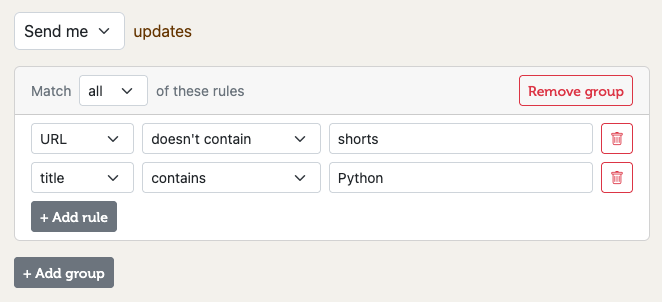
Rules
A rule is a single condition that checks part of a feed item. Each rule has three parts:
- Field - which part of the item to check:
- Title - the item's headline
- Body - the main content of the item
- URL - the link to the item
- Author - who wrote the item
- Category - the categories or tags assigned to the item
- Condition - how to check it:
- contains - matches if your search term appears anywhere in the field (not case-sensitive)
- doesn't contain - matches if your search term does not appear in the field
- Value - the text to search for
Groups
Rules are organised into groups. When a group has more than one rule, you choose whether an item must match all of the rules or just any one of them.
If you have more than one group, you also choose whether the item must satisfy every group or just either of them. This gives you a lot of flexibility to express exactly what you want.
For most people, a single group with one or two rules is all you need. Add more groups when you want to combine conditions in different ways.
Send me vs Ignore
At the top of the filter you'll see a dropdown with two choices:
- Send me - you'll only receive items that match your rules. Everything else is ignored.
- Ignore - items that match your rules are discarded. You'll receive everything else.
Advanced: pattern matching
For more powerful matching, you can use matches regex and doesn't match regex instead of the simple contains/doesn't contain conditions.
A regular expression (regex) is a special pattern that can match text in flexible ways. Here are some useful examples:
| Pattern | What it does |
|---|---|
python|django |
Matches "python" or "django" |
^Breaking: |
Matches only if the text starts with "Breaking:" |
sale$ |
Matches only if the text ends with "sale" |
v\d+\.\d+ |
Matches version numbers like "v2.0" or "v12.34" |
Regex matching is not case-sensitive. If you're not familiar with regular expressions, the contains and doesn't contain conditions will cover most use cases.
Examples
Only get posts about a specific topic
Set the action to Send me, and add one rule: title contains Laravel. You'll only receive items with "Laravel" in the title.
Hide posts from a particular author
Set the action to Ignore, and add one rule: author contains Guest Author. Posts by that author will be filtered out.
Only get posts about Python or Django
Set the action to Send me, and create a group with two rules using match any:
- title contains
Python - title contains
Django
You'll receive items that mention either term.
Get posts about Python, but not beginner tutorials
Set the action to Send me, and create a group with two rules using match all:
- title contains
Python - title doesn't contain
beginner
You'll receive items that mention Python but not those aimed at beginners.
Webhooks
Webhooks are available on Lite and Full plans. Instead of delivering feed updates by email, you can point a subscription at any HTTP endpoint - Blogtrottr will POST new items to your URL as they arrive. Custom HTTP headers are also supported, to enable passing authentication tokens or other metadata to your endpoint.
For details on delivery behaviour, retries, and the User-Agent we send, see our webhook delivery robot page.
What does the default webhook JSON payload look like?
When using the JSON webhook type, we send a POST request with a application/json content type and the following structure:
{
  "feed": {
    "title": "Example Feed",
    "description": "A description of the feed",
    "url": "https://example.com/feed.xml"
  },
  "subscription_id": "abc123",
  "items": [
    {
      "title": "Post Title",
      "link": "https://example.com/post",
      "body": "<p>The full post content</p>",
      "date": "2026-01-15T12:00:00+00:00",
      "authors": ["Author Name"],
      "categories": ["Category"],
      "thumbnail": "https://example.com/thumb.jpg"
    }
  ]
}
If you need a custom body format, choose the Form encoded or Raw webhook type instead.
How does the form encoded webhook type work?
When using the Form encoded webhook type, we send one POST request per feed item with a application/x-www-form-urlencoded content type.
You provide a body template using placeholder tags. All tag values are automatically URL-encoded. For example:
title={item_title}&url={item_link}&feed={feed_title}Available tags: {feed_title}, {feed_description}, {feed_url}, {item_title}, {item_link}, {item_body}, {item_date}
How does the raw webhook type work?
When using the Raw webhook type, we send one POST request per feed item with a text/plain content type.
You provide a body template using placeholder tags. No escaping is applied - tag values are inserted as-is. For example:
New post: {item_title}
Link: {item_link}
Feed: {feed_title}
Available tags: {feed_title}, {feed_description}, {feed_url}, {item_title}, {item_link}, {item_body}, {item_date}
Additional email addresses
Available on Lite and Full plans. Add up to 25 verified delivery addresses to your account, so different subscriptions can send to different inboxes - without needing separate Blogtrottr accounts.
What are they?
By default, all your feed updates are delivered to your main account email address. With additional email addresses, you can route individual subscriptions to any other address you've verified - a work inbox, a personal inbox, a dedicated filtering address, and so on.
Adding an address
Go to Account › Email addresses and enter the address in the field provided. We'll send a verification link to that address - click it to confirm ownership, and the address will become available to use on your subscriptions.
Using an address
When creating or editing a subscription, select one of your confirmed addresses from the Delivery address dropdown. If no additional address is selected, updates are sent to your main account email as normal.
Removing an address
Click Remove next to an address on the Email addresses page. Any subscriptions that were using it will automatically revert to your main account email address.
API
Blogtrottr provides a REST API for managing your subscriptions programmatically. See the full API documentation.
General
Autoblogging
Autoblogging is the practice of automatically posting content (usually copied without permission from other sites) to blogs or websites. Due to complaints from content owners about their work being republished, any user accounts detected using Blogtrottr for this purpose will be automatically suspended.
There are many services and software packages out there dedicated to autoblogging; if you still feel that you must do this, please go and use one of them instead.
Feed robot
Curious about how our feed-fetching robot behaves - conditional requests, WebSub, TTL handling, and request signing? Read more on our robot page.
Company details
Blogtrottr Ltd is a registered UK company, 08447594.
Registered office (please send all technical and support queries to [email protected]):
Blogtrottr Ltd
71-75 Shelton Street
Covent Garden
London
WC2H 9JQ
Getting in touch
We're always interested in hearing what people think. You can email us at [email protected]
Privacy & email
You can find full details of our privacy policy on our Policies, Terms and Conditions page.